First-Time IPPT at FCC: What to Wear, Bring, Do and Expect

TL;DR:
Going for your first IPPT at FCC is less stressful when you know the flow. Book your slot through OneNS, reach early, wear proper running attire, and bring only the basics: ID or 11B, phone, water bottle, towel, and a small bag. Expect check-in, safety briefing, push-ups, sit-ups, the 2.4km run, then results and out-processing. Don’t test new shoes, food, or supplements on the day. Use the IPPT Calculator before going so you know exactly what score you need.
Who Is This First-Time IPPT Guide For?
This guide is for you if you’re going to an FCC for the first time.
You may be an NSman after ORD. You may be a pre-enlistee going for a re-test. You may be someone who delayed IPPT until the window started to feel too close.
Same problem.
You know there’s a test. You don’t know the day’s flow.
This article is not a full training plan. For food, warm-up, and no-count prevention, read our IPPT Test Day Protocol.
This article is the practical one.
It tells you what to wear, what to bring, where people make mistakes, and what usually happens when you arrive.
What Happens During Your First-Time IPPT at FCC?
Your first session feels more stressful before you reach the centre.
Once you understand the flow, it’s not complicated. You book your slot, reach early, check in, attend the safety briefing, complete three stations, then wait for your result.
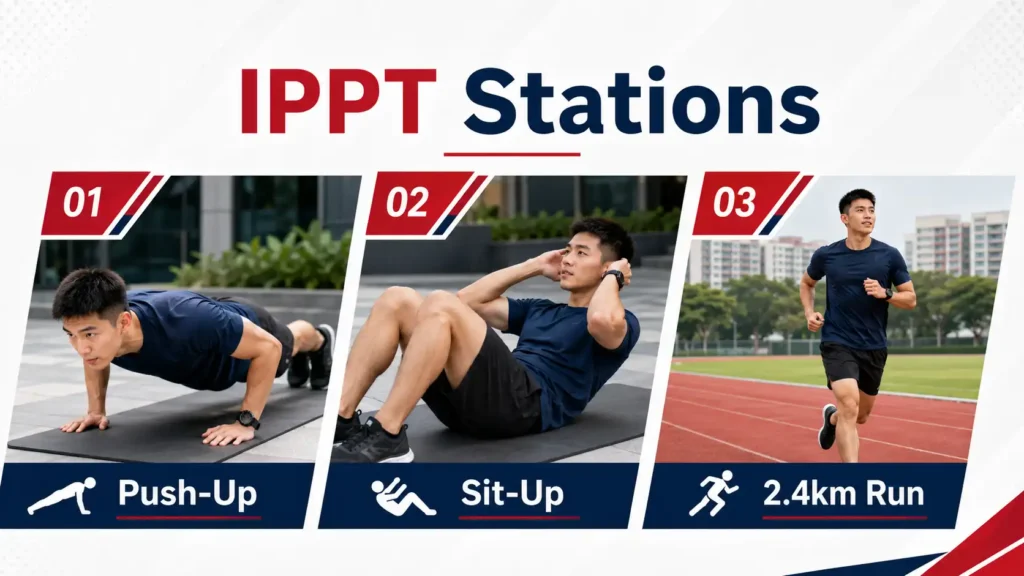
The three IPPT stations are push-up, sit-up, and the 2.4km run. MINDEF lists these as the current three stations for IPPT.
The part that catches most first-timers is not fitness.
It’s the small stuff.
Wrong shoes. Late arrival. No water. Too much food. No idea where to report. Panic after one no-count. These things can ruin a decent attempt.
This guide fixes that.
Before you go, use the IPPT Calculator to check your score. Your target should be clear before you enter the FCC. Guessing on test day is a bad plan.
What Is an FCC for IPPT in Singapore?
FCC means Fitness and Conditioning Centre.
For NSmen, an FCC is where you can take IPPT or attend FIT@FCC. It is a structured centre for fitness testing and training sessions.
MINDEF says NSmen can take IPPT at Bedok FCC, Khatib FCC, Kranji FCC, and CMPB FCC, depending on schedule and availability.
For pre-enlistees, the situation is slightly different. MINDEF says students in JC, MI, Polytechnic, or ITE usually take pre-enlistee IPPT in school. Others may book a re-test at CMPB FCC, subject to availability.
So check your profile before booking.
Don’t copy what your friend did. His route may not be yours.
| FCC | Who it suits | First-timer note |
|---|---|---|
| Bedok FCC | East-side NSmen | Check the route before the day |
| Khatib FCC | North-side NSmen | Leave buffer for entry and walking |
| Kranji FCC | West and North-West NSmen | Watch your travel time |
| CMPB FCC | NSmen and some pre-enlistees | Confirm your booking type |
The best FCC is not always the nearest one.
The best FCC is the one you can reach calmly and early.
What Should You Expect at FCC?
For your first IPPT at FCC, book your session through OneNS, arrive at least 15 minutes early, wear proper exercise attire, and bring identification, phone, water, and a towel. You’ll complete check-in, safety briefing, push-ups, sit-ups, the 2.4km run, results, and out-processing.
MINDEF says IPPT and FIT@FCC sessions are held at four Fitness and Conditioning Centres. These are Bedok, Khatib, CMPB, and Kranji FCC. It also says each session takes about 1.5 hours, including in-processing, out-processing, and safety briefing.
That 1.5-hour figure is a good planning number.
Don’t plan a meeting right after your session. Don’t book a tight dinner. Don’t assume you’ll walk in and out in 30 minutes.
Give yourself space.
How Do You Book Your First IPPT Session?
Book your IPPT through OneNS.
MINDEF says NSmen can book IPPT or NS FIT up to three months in advance. Morning and afternoon bookings close by 0000 hrs. Evening bookings close by 1200 hrs on the test date.
Book early if you can.
Late booking creates bad choices. You may get a slot that clashes with work. You may end up travelling across Singapore after a long day. You may also train with less focus because the date keeps changing.
Here is the simple booking check
| Booking item | What to check |
|---|---|
| Session type | Make sure it says IPPT |
| Location | Confirm the FCC before test day |
| Date and time | Screenshot the booking |
| Travel route | Check MRT, bus, taxi, or driving time |
| Cut-off time | Amend early if plans change |
| Work schedule | Avoid a session after a draining day |
A small opinion here.
Don’t treat booking as admin.
Treat it as part of the test. A bad slot can make a fit person perform badly.
How Early Should You Arrive for IPPT at FCC?How Early Should You Arrive for IPPT at FCC?
Reach at least 15 minutes before the session starts.
That is not a random tip. MINDEF says participants must report 15 minutes before IPPT starts. This helps with in-processing and session flow.
My honest advice is stricter.
For your first IPPT at FCC, aim to reach the area 30 minutes early.
Not the gate. Not the MRT station. The area.
Why?
Because first-timers waste time in boring ways. They look for the entrance. They check signs twice. They wonder if they’re at the correct reporting area. They open OneNS again. They queue behind people who already know the routine.
That’s normal.
So plan for it.
| Arrival timing | What it means |
|---|---|
| 30 minutes early | Best for first-timers |
| 15 minutes early | Official reporting target |
| On the dot | Risky |
| Late | You may need advice from the Conducting Officer |
Don’t start your test day by rushing.
A rushed arrival raises your heart rate before the first station.
What Should You Wear for IPPT at FCC?
Wear simple running attire.
That means a light top, exercise shorts, socks, and proper running shoes. Avoid jeans, slippers, thick cotton, restrictive shorts, and brand-new shoes.
For first-time IPPT at FCC, comfort beats style.
You need clothing that lets you move cleanly. You also need shoes that feel safe during the 2.4km run.
| Wear this | Avoid this |
|---|---|
| Light T-shirt or singlet | Heavy cotton shirt |
| Exercise shorts | Jeans or bermudas |
| Running shoes | Slippers or casual shoes |
| Socks you’ve worn before | New socks that rub |
| Simple watch | Loose accessories |
| Clothes you trained in | Brand-new test-day outfit |
Don’t wear a new pair of shoes for IPPT.
I’ve seen this mistake too many times in fitness settings. The person thinks new shoes will help. Then the heel rubs. The foot feels strange. The run becomes a negotiation with pain.
Test-day gear should be boring.
Boring is good.
You want no surprises from your clothes, shoes, or socks.
What Should You Eat Before Your First IPPT?
Keep food boring.
Eat something familiar. Don’t test a new meal before IPPT. Don’t arrive too full. Don’t arrive starving either.
MINDEF advises avoiding a meal within one hour of the test. It also gives hydration and sleep advice for the night before IPPT.
For most people, a normal light meal earlier works better than a heavy meal near reporting time.
Examples:
| Timing | Better choice |
|---|---|
| 3 to 4 hours before | Normal meal with carbs and protein |
| 1 to 2 hours before | Light snack, if needed |
| Last hour | Avoid a full meal |
| Right before test | Small sips of water |
Don’t copy fitness influencers here.
IPPT is not the day for experiments.
What Should You Bring for Your First IPPT?
Pack light.
Bring only what helps you get through entry, testing, and travel home. Don’t carry your whole life into the FCC.

| Item | Why it helps |
|---|---|
| Identification or 11B, where applicable | Needed for checks and entry |
| Phone | Booking proof and OneNS access |
| Water bottle | Hydration before and after |
| Small towel | Useful after the run |
| Change of clothes | Good for work or public transport |
| Small bag | Keeps things together |
| Medication, if needed | Only if prescribed or relevant |
| Cash or card | Transport or emergency use |
Don’t bring too many valuables.
You’ll be moving between check-in, stations, waiting areas, and out-processing. A lighter bag means less stress.
Also, don’t bring new supplements.
This is not the day to test a pre-workout drink. Your stomach may not enjoy it. Your 2.4km run will make sure you know.
If you need food guidance, use our IPPT Test Day Protocol. It covers timing, water, and what to avoid before testing.
What Happens When You Arrive at the FCC?
Most FCC sessions follow a simple flow.
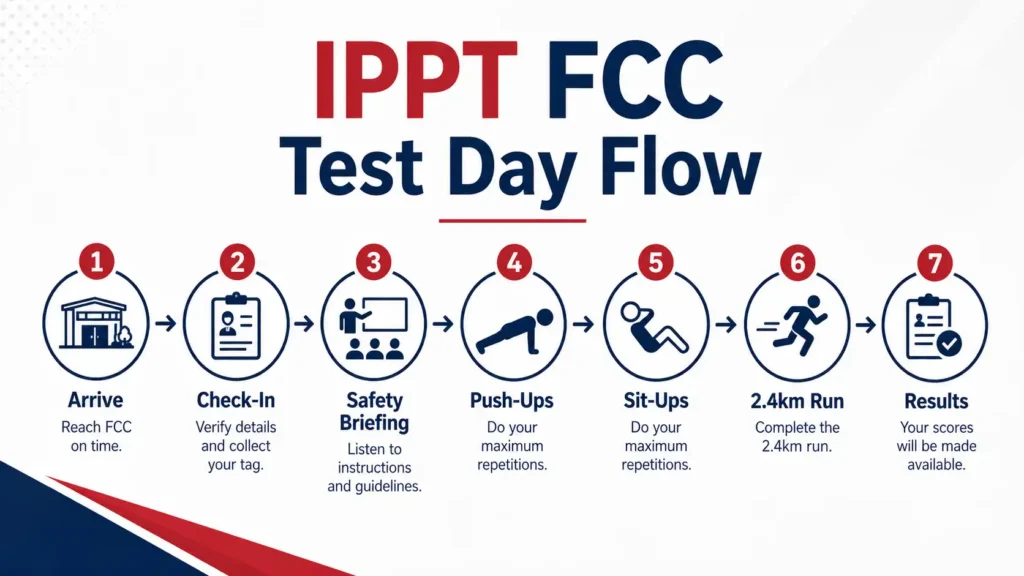
You arrive. You report. Staff verify your session. You wait. You attend briefing. Then you move through the test stations.
Here is the usual step by step first-timer flow.
- Arrive at the camp or FCC area
- Follow signs or staff instructions
- Show identification or booking details
- Complete in-processing
- Wait for the safety briefing
- Move to push-up station
- Move to sit-up station
- Complete the 2.4km run
- Wait for results and out-processing
Will every FCC feel exactly the same?
No.
Crowd size, session timing, and staff flow can change the experience. But the big steps stay similar.
The most useful mindset is this.
Follow instructions. Don’t overthink. Ask early if you’re unsure.
First-timers sometimes stay silent because they don’t want to look blur. That’s silly. Ask the staff where to report if you’re unsure.
A 10-second question can save 10 minutes of wandering.
What Happens at the Push-Up Station?
The push-up station is where strong people can still lose points.
Not because they’re weak.
Because their reps don’t count.
The machine and station rules care about clean movement. Your body position, arm lockout, and depth matter. If you trained messy reps at home, the station may expose it fast.
For a first-timer, don’t rush the first 15 seconds.
Start with control. Find the sensor rhythm. Build speed only after the first few reps count.
| Common push-up mistake | Better move |
|---|---|
| Starting too fast | Start clean, then speed up |
| Hips sagging | Keep your body straight |
| Half reps | Hit the required range |
| Looking around | Focus on your own count |
| Panicking after no-count | Reset your form |
One failed rep is not the end.
But five messy reps can cost your pass.
For form fixes, read the push-up section inside our IPPT Calculator guide. It explains how form affects points.
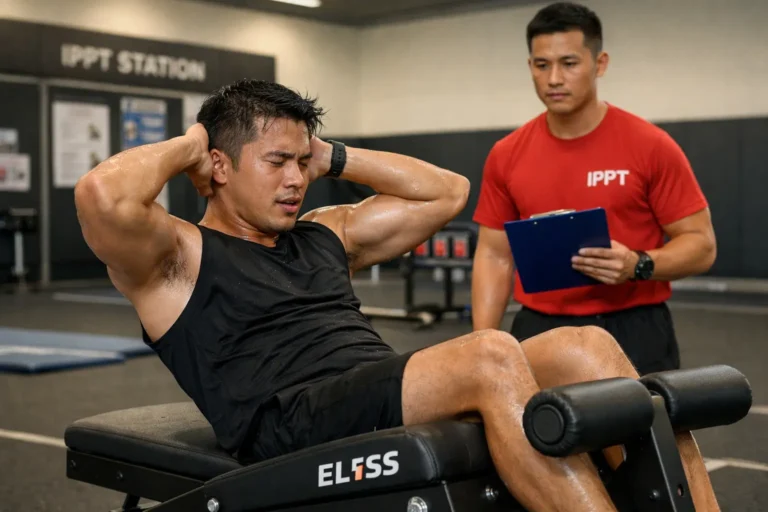
What Happens at the Sit-Up Station?
The sit-up station feels easier than push-ups until the clock starts.
Then people rush.
They pull with the neck. They lose rhythm. They gas out halfway through the minute.
Your goal is not to do the fastest first 20 seconds.
Your goal is to finish the full minute with counted reps.
Keep the movement clean. Breathe. Don’t jerk your body. Don’t waste energy fighting the setup.
| Common sit-up mistake | Better move |
|---|---|
| Flying up too fast | Use a steady rhythm |
| Pulling the neck | Let the core work |
| Resting too long | Take short pauses |
| Losing position | Reset fast |
| Chasing someone else | Follow your own pace |
The sit-up station rewards rhythm.
If you’ve only trained random sets at home, practise one-minute sets before test day.
That one habit helps a lot.
What Happens During the 2.4km Run?
The 2.4km run decides many first-time attempts.
Push-ups and sit-ups can save you. But the run usually exposes your training.
The biggest mistake is starting like a hero.
Don’t do that.
Start controlled. Run the first part at a pace you can hold. Then push harder near the end.
| Run mistake | What to do instead |
|---|---|
| Sprinting the first lap | Start at target pace |
| Checking others too much | Track your own timing |
| Drinking too much right before | Sip earlier |
| Giving up after one slow lap | Adjust and keep moving |
| No target time | Use the calculator first |
A simple case example helps.
A first-time NSman I’ll call “Daniel” could do decent push-ups and sit-ups. His training run was around 14 minutes. On test day, he ran the first lap too fast and finished badly. He missed his pass by a few points.
Two weeks later, he used a boring pace plan.
Same fitness. Better control.
He passed because he stopped racing the first lap.
That’s not a magic training method. It’s just less ego.
What Happens After Your IPPT Results?
After the stations, wait for your result and out-processing.
Your result will show whether you failed, passed, or reached an award band. Use it properly.
If you passed, check whether your annual requirement is cleared. If you failed, don’t treat the attempt as wasted.
A failed attempt gives you useful numbers.
You’ll know which station cost you points. You’ll also know whether your next move should be training, another IPPT attempt, or NS FIT.
MINDEF says if an NSman attempts IPPT but does not pass, he should continue to attempt and pass IPPT, or choose NS FIT. If he joins NS FIT after one failed IPPT, he only needs to complete the remaining nine NS FIT sessions within the window.
Use the result like feedback.
Not judgment.
What If You Are Late for IPPT?
If you’re late, don’t disappear.
MINDEF says late participants should approach the Conducting Officer for advice when they arrive. The officer can advise how they may still participate.
That does not mean lateness is harmless.
It means you should still report and ask.
For your first-time IPPT at FCC, assume travel will take longer than expected. Trains delay. Bus walks feel longer. Camp entrances confuse people. Rain slows everything.
A 15-minute buffer is official.
A 30-minute buffer is smarter.
What If You’re Sick or Cannot Attend IPPT?
Don’t force an attempt when you’re unwell.
MINDEF’s safety advice says you should not attempt IPPT if you have a valid medical certificate for the last three days before test day. It also advises at least seven hours of sleep before IPPT, proper hydration, and avoiding meals within one hour of the test.
If you cannot attend, cancel or amend early.
MINDEF advises cancellation so the slot becomes available to other NSmen. It says morning and afternoon session changes must be done before 0000 hrs. Evening session changes must be done before 1200 hrs.
Don’t just ignore the booking.
That is the worst option.
If something is wrong, handle it early.
Which FCC Is Best for First-Time IPPT?
Pick the FCC that gives you the least stress.
That is my strong answer.
People like to ask which FCC is easier. The better question is this.
Which FCC can you reach early, calm, and ready?
For most first-timers, the answer is not about the track. It’s about travel, timing, and familiarity.
| FCC choice factor | Why it matters |
|---|---|
| Travel time | Long travel drains energy |
| Session time | Evening slots may feel tiring |
| Entry familiarity | New locations cause stress |
| Weather buffer | Rain can slow travel |
| Work schedule | Bad timing affects performance |
| Return trip | You may be sweaty and tired |
If you live in the east, Bedok may make sense.
If you live in the north, Khatib may feel easier.
If you live nearer the west, Kranji may work.
If you’re central or a pre-enlistee with CMPB access, CMPB may be relevant.
But don’t chase rumours.
A calm arrival beats a “better” centre across the island.
What Mistakes Should First-Timers Avoid?
Most first-time mistakes are preventable.
Here are the ones I’d fix first.
| Mistake | Why it hurts |
|---|---|
| Booking too late | Bad slots increase stress |
| Reaching on the dot | You start the day rushed |
| Wearing new shoes | Blisters can ruin the run |
| Eating too much | The run feels awful |
| Drinking too much right before | You feel heavy |
| Chasing others | You lose your pace |
| Ignoring no-counts | Reps disappear fast |
| Not checking your target score | You test blindly |
Another case example.
A reader-style scenario I see often is the “one station rescue” problem. Call him “Amir.” He needed a pass. His push-ups were weak, so he trained only push-ups for two weeks.
Bad move.
His run was also borderline. On test day, he gained two push-up points but lost more on the 2.4km run. He failed again.
The fix was simple.
Use the calculator first. Find the easiest points. Train the weakest station, but protect the others.
That’s how smart test prep works.
How Can You Prepare the Night Before?
The night before IPPT should feel boring.
That’s the point.
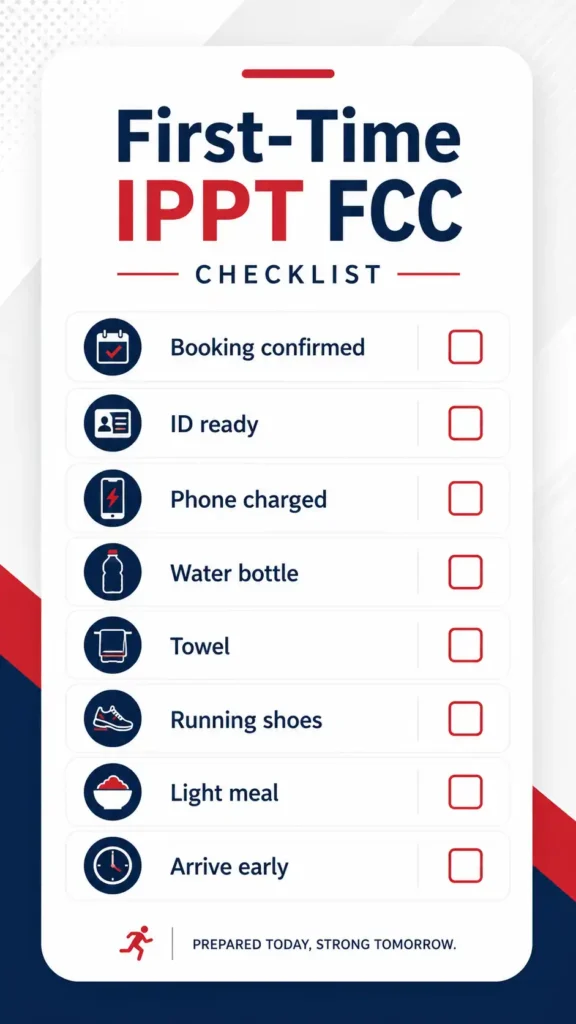
Charge your phone. Screenshot your booking. Pack your bag. Check the route. Lay out your clothes. Sleep early.
Don’t do a hard workout.
Don’t run intervals.
Don’t test max push-ups at midnight.
You won’t gain fitness overnight. You can only lose freshness.
Use this checklist.
| Night-before task | Done |
|---|---|
| Booking screenshot saved | ☐ |
| FCC route checked | ☐ |
| ID or 11B prepared | ☐ |
| Clothes ready | ☐ |
| Shoes and socks ready | ☐ |
| Water bottle packed | ☐ |
| Alarm set | ☐ |
| Target score checked | ☐ |
The last one matters.
Open the IPPT Calculator and know your numbers.
Don’t wait until after the test to understand the score.
How Should You Warm Up at FCC?
Warm up enough to move well.
Don’t tire yourself out.
A good warm-up should raise your body temperature. It should also prepare your joints for push-ups, sit-ups, and running.
Try this simple flow.
| Warm-up move | Time |
|---|---|
| Easy walk or light jog | 3 to 5 minutes |
| Arm circles and shoulder rolls | 1 minute |
| Hip circles and leg swings | 1 minute |
| Easy push-ups | 5 to 8 reps |
| Easy sit-ups | 5 to 8 reps |
| Short relaxed strides | 2 to 3 rounds |
Don’t chase sweat.
Chase readiness.
A first-timer often does too much because he feels nervous. Save that energy for the test.
How Do You Handle No-Counts Without Panicking?
No-counts happen.
They’re annoying, but they don’t need to destroy your attempt.
If you get a no-count, fix one thing fast. Don’t complain mid-set. Don’t stare at the display. Don’t argue with the machine while the clock runs.
For push-ups, check depth and lockout.
For sit-ups, check range and rhythm.
For the run, don’t worry about no-counts. Worry about pace.
If no-counts are your biggest fear, read our IPPT Test Day Protocol. That guide focuses more on performance and machine issues.
This guide focuses on first-timer logistics.
Together, they cover the full day.
Should You Attempt IPPT or Choose NS FIT?
If you can pass, attempt IPPT.
That’s my view.
A pass clears the stress faster. It also gives you a clear result. Even a failed attempt gives you data.
If you’re far from passing, NS FIT may be the more realistic route. The choice depends on your score, window, and time left.
Read our NS FIT Ultimate Guide if you’re unsure about NS FIT sessions, IPPT windows, or the 10-session route.
Don’t make the choice based on fear.
Make it based on numbers.
That is why the calculator exists.